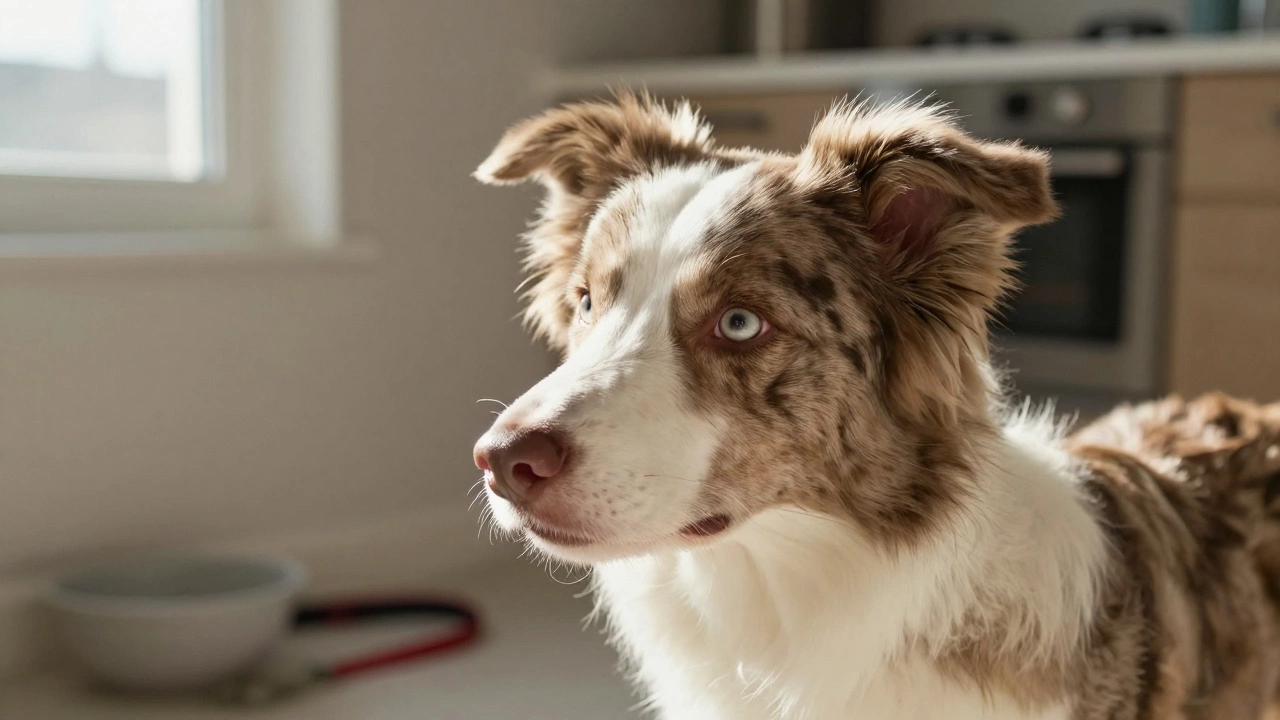
Ever noticed your dog tilting their head when you speak? It’s cute, sure-but it’s not just for charm. That sideways head angle is your dog’s brain at work, trying to make sense of what you’re saying. It’s not random. It’s a mix of hearing, vision, and social processing all happening in real time.
It’s About Sound Location
Dogs hear a wider range of frequencies than humans. They can pick up sounds as high as 65,000 Hz, while we max out around 20,000 Hz. But their ears aren’t like ours. They’re shaped like funnels, and they move independently. When your dog tilts their head, they’re adjusting the position of their ear flaps to better capture the direction and tone of your voice.Think of it like turning up the volume on a speaker. By tilting, they’re aligning their ear canal to catch the subtle shifts in your pitch-especially when you say their name or a word they’ve learned, like "walk" or "treat." Studies from the University of Budapest found that dogs who know dozens of toy names tilt their heads more often when asked to fetch one. The more familiar the word, the more they adjust.
They’re Trying to See Your Face
Dogs don’t have binocular vision like humans. Their eyes are set a little wider, giving them better peripheral sight but less depth perception directly in front. When you’re talking, your mouth moves. That’s important. Dogs read your facial expressions to understand emotion and intent.That head tilt? It’s a visual repositioning. By shifting their head sideways, they’re clearing their muzzle out of the way. Suddenly, they get a clearer view of your mouth, eyes, and eyebrows. It’s like they’re saying, "Wait, I need to see how you’re saying that."
Researchers at the University of Lincoln filmed 59 dogs during verbal commands. Dogs with longer muzzles tilted their heads more than those with flat faces. Why? Their snouts block the view more. A Pug doesn’t need to tilt as much as a German Shepherd does. It’s a physical adaptation.
It’s a Learned Social Response
Here’s the thing: dogs are social learners. They pick up on what gets attention. If you smile, coo, or give a treat when they tilt their head, they’ll do it again. It’s not just instinct-it’s reinforcement.One owner in Auckland told me her Border Collie, Luna, tilts her head every time she says "time for dinner." She’s never been trained to do it. But every time she does, her owner says, "Aww, look at that!" and scratches her ears. Luna learned: tilt = good things happen.
This isn’t manipulation. It’s bonding. Dogs use body language to connect. Head tilting is part of their social toolkit, along with wagging, whining, and eye contact. It’s their way of saying, "I’m listening. Tell me more."

Brain Activity Behind the Tilt
Neuroscientists at Eötvös Loránd University in Hungary used fMRI scans on dogs to see what happens in their brains during human speech. When dogs heard familiar words like "sit" or "stay," their left hemisphere lit up-the same side humans use for language processing. When they heard nonsense words, the right side activated, which handles emotional tone.The head tilt? That’s the moment the brain switches between these two systems. One second, they’re analyzing the meaning of your word. The next, they’re reading how you feel about it. The tilt is the physical sign of that cognitive shift. It’s not a reflex. It’s a decision.
Not All Dogs Do It
Some dogs rarely tilt their heads. That’s normal. It doesn’t mean they’re less intelligent or less bonded. Dogs with hearing loss, ear infections, or neurological issues might not tilt at all. If your dog suddenly stops tilting when they used to-or starts tilting constantly without being spoken to-it’s worth a vet check.Ear infections are common. They cause discomfort, imbalance, or even dizziness. A dog with an ear infection might tilt their head to one side all the time, not just when you talk. That’s a red flag. Same with vestibular disease, which affects balance. It’s more common in older dogs and can mimic a head tilt.

What You Can Do
If your dog tilts their head when you talk, celebrate it. It’s a sign they’re engaged. Try this: vary your tone. Say "good boy" in a high, excited voice. Then say it in a low, calm whisper. Watch how their head moves. You’ll see them adjust differently for each.Don’t reward the tilt with treats every time. That trains them to do it on command. Instead, let it be natural. Let it be part of your conversation. That’s what they’re after-not a treat, but connection.
And if your dog doesn’t tilt? That’s okay too. Some dogs communicate with tail wags, ear flicks, or just a steady gaze. There’s no one right way to listen.
When to Worry
A one-time head tilt during conversation? Totally normal. A constant tilt, especially if paired with:- Loss of balance
- Circling or falling over
- Loss of appetite
- Eye twitching or nystagmus (rapid eye movement)
…then it’s time to see a vet. These signs point to inner ear problems, neurological issues, or even a brain lesion. Early detection matters. A simple ear exam or CT scan can rule out serious causes.
Most dogs tilt their heads because they care. They’re trying to understand you. To hear you better. To see you clearer. To stay in the conversation. It’s one of the most human-like things they do-and it’s all rooted in their need to connect with you.
Do all dogs tilt their heads when we talk to them?
No, not all dogs tilt their heads. Some breeds, especially those with flatter faces like Pugs or Bulldogs, do it less often because their muzzle doesn’t block their view as much. Also, dogs with hearing problems, ear infections, or neurological conditions may not tilt at all-or may tilt constantly, which is a sign to see a vet.
Is head tilting a sign of intelligence in dogs?
It’s not a direct measure of intelligence, but it does suggest strong social awareness. Dogs that tilt their heads more often tend to be better at learning word associations, like knowing the names of toys. A 2022 study found that "gifted" dogs-who could recall over 100 toy names-tilted their heads 43% more than average dogs when asked to fetch one.
Can head tilting be harmful?
The act of tilting its head during conversation is completely harmless. But if your dog tilts their head constantly, even when you’re not talking, or if they seem dizzy, unsteady, or have eye twitching, it could indicate an ear infection, vestibular disease, or neurological issue. These need veterinary attention.
Why do dogs tilt their heads more when we say their name?
Dogs recognize their names as important cues. When they hear it, their brain shifts into high gear-trying to process both the meaning ("I’m being called") and the emotional tone ("Is this good or bad?"). The head tilt helps them better hear the pitch and see your facial expression, helping them respond appropriately.
Should I encourage my dog to tilt their head?
You don’t need to train it. It’s a natural behavior that strengthens your bond. If you reward it every time, you might turn it into a trick. But if you let it happen on its own, you’re reinforcing genuine communication. That’s more valuable than any trick.