Pet Flight Cost Calculator
Your Pet's Travel Details
Recommended Options
Enter your pet details to see recommendations
Planning to fly with your pet? You’re not alone. Every year, over 2 million pets travel by air in the U.S. alone, and the numbers keep rising. But not all airlines treat pets the same. Some make it easy. Others? Not so much. If you’ve ever stared at a flight booking page wondering which carriers actually let your dog or cat come along - and how - you’re in the right place.
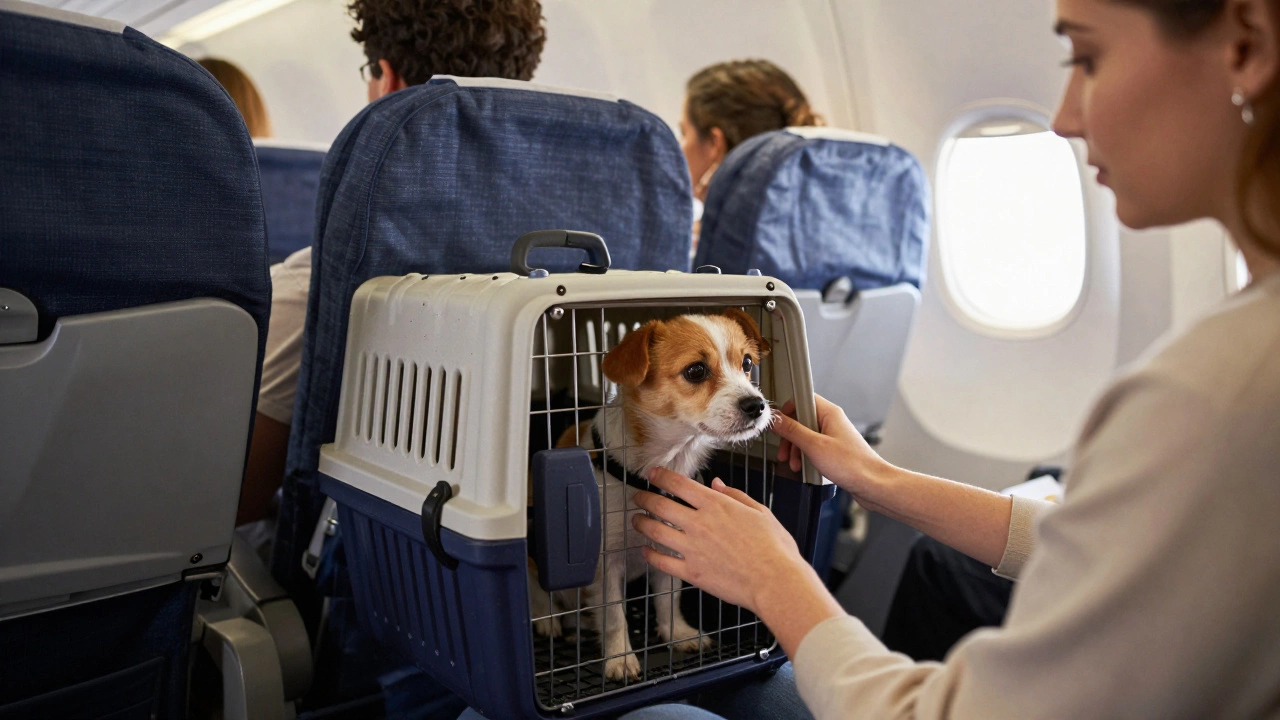
Which airlines allow pets in the cabin?
Most major U.S. airlines let small dogs and cats fly in the cabin, as long as they fit under the seat in an approved carrier. The carrier must be hard-sided, leak-proof, and small enough to fit in the space beneath the seat in front of you. Soft-sided carriers are usually okay too, as long as they meet size limits. Airlines like Delta Air Lines a U.S.-based airline that allows small pets in the cabin with size restrictions and fees, United Airlines a global airline with pet travel policies for both cabin and cargo, and American Airlines a major U.S. airline offering pet transport services with specific carrier requirements all permit in-cabin pets. But here’s the catch: they limit the number of pets per flight. Usually, it’s just 2 to 4 per plane. Book early.
International carriers like Air Canada a Canadian airline with pet travel policies similar to U.S. carriers and Lufthansa a German airline that allows pets in cabin and cargo with strict documentation rules have similar rules. But if you’re flying from Europe or Asia, check their websites. Some, like British Airways a UK-based airline that only allows service animals in cabin, only allow service animals in the cabin - no pets.
What about pet cargo? Is it safe?
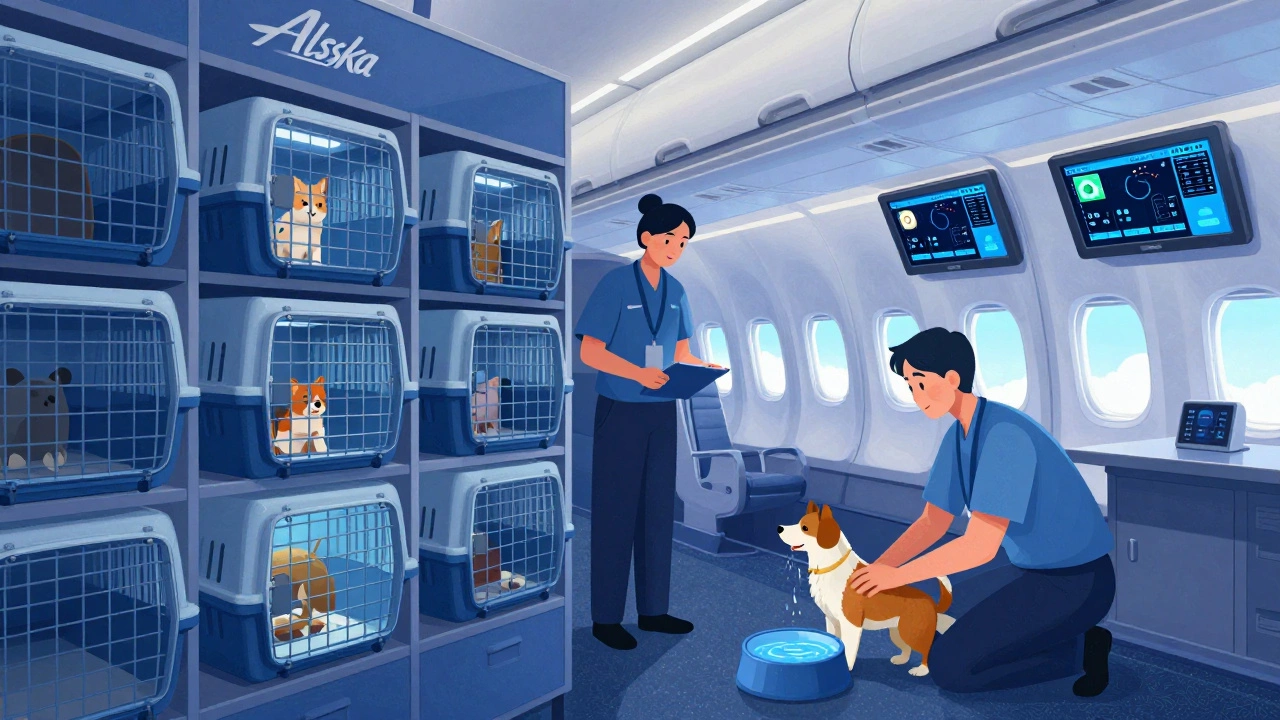
If your pet is too big for the cabin - say, a 60-pound dog - you’ll need to ship them as cargo. This isn’t the same as luggage. Airlines have climate-controlled, pressurized holds just for pets. But not all airlines handle cargo the same way. Alaska Airlines a U.S. airline known for its pet-friendly cargo policies and low incident rates is widely praised for its safety record. They track every pet, provide water, and even have staff check on them during layovers. Southwest Airlines a U.S. airline that does not offer pet cargo services doesn’t allow cargo pets at all. They only let small pets in the cabin.
Some airlines have banned cargo travel during extreme weather. Delta Air Lines and United Airlines pause pet cargo when temperatures hit 85°F (29°C) or drop below 20°F (-6°C). That’s because heatstroke and hypothermia are real risks. Always check the weather forecast for departure, arrival, and layover cities before booking.
Costs: How much does it really cost to fly with a pet?
There’s no getting around it - flying with pets costs money. In-cabin fees range from $100 to $200 each way, depending on the airline. JetBlue a U.S. airline with a flat $125 fee for in-cabin pets charges $125 one-way, which is among the lowest. Frontier Airlines a U.S. budget airline with higher pet fees and strict policies charges $150, but adds a $50 fee if you check in at the airport instead of online. Watch out for those hidden costs.
Cargo fees? They’re a whole different ballgame. You’re looking at $300 to $700 one-way, depending on your pet’s weight, the route, and how far in advance you book. American Airlines Cargo a pet transport division of American Airlines offering cargo services with variable pricing charges based on the container size and distance. A 70-pound dog flying from New York to Los Angeles might cost $550. Add in vet paperwork, a health certificate, and a travel crate - and you’re easily over $700.
What paperwork do you actually need?
It’s not just about booking a ticket. You need documents. For domestic flights in the U.S., you’ll need a health certificate from a licensed vet, issued no more than 10 days before your flight. Some airlines require it to be no older than 7 days. Your pet must also be up to date on rabies vaccination. If you’re flying internationally, it gets more complex. The EU, Australia, and New Zealand require microchips, specific vaccines, blood tests, and even quarantine periods. Australian Department of Agriculture a government agency regulating pet import rules into Australia requires a 10-day quarantine for cats and dogs, even if they’re fully vaccinated.
Don’t skip the microchip. It’s required by most international airlines and is your pet’s best shot at being returned if they get lost. The chip must be ISO-compliant (134.2 kHz). If your pet has a non-standard chip, bring a scanner - some airports don’t have the right equipment.
Which airlines are the most pet-friendly?
Not all airlines treat pets like cargo. Some go out of their way to make it easier. Here’s who stands out:
- Alaska Airlines - Best for cargo pets. They have a dedicated pet care team, real-time tracking, and no temperature bans. They even offer a 10% discount for repeat pet travelers.
- Delta Air Lines - Best for overall service. They offer pet-friendly check-in counters, climate-controlled holds, and trained staff who monitor pets during layovers.
- JetBlue - Best for cabin pets. Low fees, no weight limits (just size), and they let you bring two small pets per passenger.
- Air Canada - Best for international routes. They’ve streamlined documentation for flights to the U.S. and Europe.
On the flip side, avoid Frontier Airlines if your pet is nervous. They don’t allow pets on flights with layovers longer than 2 hours. And Spirit Airlines a U.S. budget airline with very limited pet policies only allows service animals. No pets.

What about exotic pets? Birds, rabbits, or reptiles?
Most airlines only allow dogs and cats. A few, like United Airlines and American Airlines, will carry birds - but only in cargo, and only with extra paperwork. Reptiles? Almost never. Ferrets? Only if they’re service animals. If you’re flying with anything other than a dog or cat, call the airline directly. Don’t assume anything.
Pro tips for flying with pets
- Book direct flights. Layovers mean more stress, more handling, and more risk.
- Use a crate that’s one size larger than the minimum requirement. Your pet needs room to turn around.
- Feed your pet a light meal 4-6 hours before flying. Don’t give food right before takeoff - nausea is common.
- Put an absorbent pad in the crate. Accidents happen. A pee pad is better than a soaked carrier.
- Attach a recent photo of your pet to the crate. Ground staff might need to confirm identity.
- Never sedate your pet. Airlines ban sedatives because they can be dangerous at altitude.
If you’re flying internationally, start planning 4-6 months ahead. Some countries require blood tests, waiting periods, and even quarantine. New Zealand, for example, requires a 10-day quarantine for all incoming pets - even from Australia. That’s not something you find out at the airport.
What if your pet has anxiety?
Many pets panic in carriers or during flights. Talk to your vet. They can recommend calming supplements like L-theanine or melatonin - but only if they’re approved for travel. Some vets also suggest behavior training: get your pet used to the carrier weeks before the flight. Leave it out with treats inside. Let them nap in it. Make it a safe space.
Don’t rely on anxiety wraps or pheromone sprays alone. They help, but they’re not magic. The best thing? A familiar blanket or toy. Something that smells like home.
Can I fly with my pet in the cabin if it’s over 20 pounds?
No. Most airlines limit in-cabin pets to under 20 pounds, including the carrier. If your pet is heavier, you’ll need to ship them as cargo. Some airlines, like Alaska Airlines, allow slightly larger pets in cargo with no weight cap, as long as the crate meets size standards.
Do all airlines require a health certificate?
Yes, for domestic flights within the U.S., a health certificate from a vet issued within 10 days of travel is required by every airline. For international travel, requirements vary by country - some need 30-day-old certificates, blood tests, or microchip registration. Always check the airline and destination country’s rules.
Can I bring two pets on one flight?
Some airlines allow two small pets per passenger in the cabin, as long as they’re in one carrier and both are under 20 pounds. JetBlue and Delta allow this. Others, like United, only allow one pet per passenger. Always confirm before booking.
Is it safer to fly with my pet in the cabin or cargo?
Cabin travel is generally safer. Pets are with you, in a controlled environment, and not exposed to temperature extremes or rough handling. Cargo is safe too - if you choose an airline with a strong pet safety record, like Alaska or Delta. Avoid flying during extreme weather, and always pick direct flights.
What should I do if my pet’s flight gets delayed?
Call the airline immediately. If your pet is in cargo, ask if they’re being monitored, fed, or given water. Most major airlines have pet care teams that check on animals during delays. If you’re at the airport, ask to see your pet. If they’re not being cared for, ask to speak to a supervisor. Delayed pets are not uncommon - but neglect is.